Should the working class get in bed with technocracy?
- how the Danish government needs to combine the best and not the worst of two approaches to politics

By Joachim Skanderby Johansen
In their latest term (2019-2022) the Social Democratic government in Denmark revived class-centred left-wing politics by seeking to acknowledge and reward the working class. However, the newly formed Danish government, with prime minister Mette Frederiksen still at its helm, includes a new party that explicitly doesn’t acknowledge politics as a left vs. right struggle, which was the true north of the previous government’s political compass. Instead, the new party – the Moderates (Moderaterne) – believe that politics can and should transcend this struggle and instead be construed as series of technical problems without reference to the left vs. right division. This fault line between the two parties makes the new government an interesting case study of how – if at all – social democratic and technocratic ideology can come together.
The Social Democratic Party 2019-2022 – pride and nostalgia
Mette Frederiksen opened her speech to the Parliament in October 2019 with a seemingly odd but revealing tale of her political vision. She described how a blacksmith in Denmark, who saw that the engineer’s blueprint didn’t fit reality, used to be able to tell the engineer to get the blueprint fixed. However, the culture which facilitated that the working man could tell the academic that his plan was erroneous was now under threat from the centralisation of public services, American capital funds, greedy banks and the climate crises, to name a few. The re-establishment of the voice and recognition of the working man and woman was set out as a cornerstone of Mette Frederiksen’s Social Democratic government. Two reforms can serve as examples of how this was implemented into concrete policies and the government’s political rhetoric.
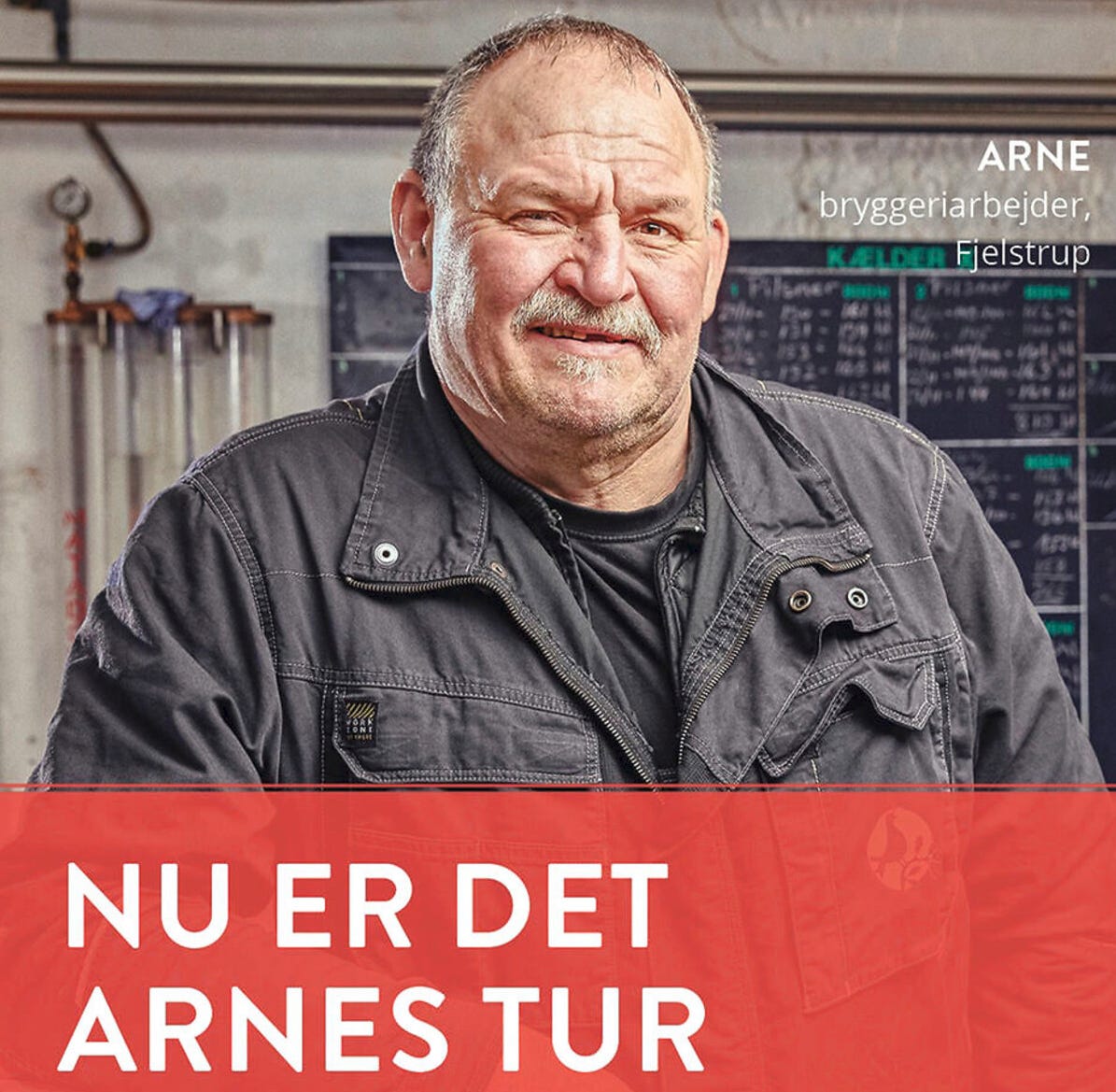
First, the so-called Arne pension reform, which granted Danes who had been on the labour market the longest the right to an earlier retirement. The reform was named after a former brewery worker, who would be able to retire due to the reform. The intended receivers of this pension were made explicit: people without a higher education who had entered the labour market early. Further, the reform was explicitly not universal and thus not a new “basic right”; for example, it would be lowered if one had pension savings of more than 2 million DKK. The intention and communication around the reform was simple and summarized in the Social Democrats’ slogan for the period; “Now it’s Arne’s turn” – the clear implication being that Arne and his fellow workers had not been granted what they were due before, but that this was about to be rectified. It was a reform not made with reference to the supply and demand on the labour market, nor to fundamental rights but with the explicit aim of recognising the contribution of a certain group – the worker – in the Danish society. A central source of financing for this new pension was the introduction of a new tax on the financial sector –which was frequently scolded by the government – further segmenting how the redistribution of riches and recognition was consciously aligned in Social Democratic politics of the time.
Another example of workerist politics was the investment in skilled workers as part of the government policy package of 2021. Under the headline “more and better-skilled workers”, the government proposed to raise the benefits for unemployed skilled workers that sought to shift professions and to create new climate-oriented schools to ensure that skilled professionals had the competencies to underpin the green transformation of the economy. Rather than an explicit recognition as with the Arne pension, these policies were primarily an interpretation of the need of the economy. Rather than invest in engineering schools or support startups working on the green agenda – which many in the public discourse on climate change might have suggested – the previous government instead chose to focus on the importance of skilled workers, seeing their contribution to the green transition as valuable by giving them a stake in a recognized critical agenda in society.
The upshot here is that policies spearheaded by the Social Democrats where not merely made with reference to some necessary re-distribution or better “social insurance” but with explicit reference to the desert, value, and recognition of the working class.
We might place this political logic of the Social Democrats in a more general framework – I’ll call this general position “recognitionist” and hope the reader will forgive the creativity. In essence, the logic is closely tied to the orthodox view of politics as a struggle between the left and the right, representing the interests of a particular class or group. As such, the function of a left-wing party is to ensure both the recognition and material welfare of the working or lower class. Thinking of politics as a question of the different classes or groups struggling for recognition thereby becomes closely integrated into the very essence of what politics is about. While the Social Democrats exemplify a central-left take on politics as a battle for recognition, the general logic is not exclusively left-wing – the group struggling for recognition may as well be defined by ethno-national boundaries as by class boundaries. However, the common thread for these politics is that the group of people which the political party represents stands in an antagonistic relation to other group’s struggling for recognition: The dignity of the working class is always, at least potentially, threatened by impoverishment and ridicule from the middle or upper classes. In the same manner, if we define groups ethnically the dignity of the “true Dane” is always, at least potentially, threatened by the presence of foreign cultures and corporate interests. In this light, any politics that claims to be free of group allegiances is viewed with suspicion.
Follies of recognitionist politics
The recognitionist approach to politics, with its focus on narratives and symbols, also appear to have a tendency or willingness to engage in policies where the intention behind the policy fits their ideological aim, but where the technical understanding – or respect for technical understanding - of the problem is lacking. We can look to the previous Danish government for a couple of examples.
Just before the election, Mette Frederiksen was vocal in the media proposing to implement more severe punishment for certain types of violence, despite researchers calling out that this had no documented effect in reducing crime and that experts had not been heard on the issue- The lack of inclusion of technical expertise makes one suspect that the government was more concerned with the values that the policy portrayed (tough on crime) than the effects of the policy.
Another example – here taken from Sigge Winther’s book, The Entrepreneurial State – was the removal of a research report from the website of the Ministry of Integration. The report, which was paid for by an agency under the Ministry, recommended education in Arabic as part of initiatives to mitigate social control and so-called honour-related conflicts. However, the Minister of Integration at the time, Matthias Tesfaye, explained that having the report available at the ministry’s website could cause confusion as the public might believe that the government supported the recommendations made by the researchers in the report.

This points to a foundational weakness of recognitionist politics. Seeing politics as a foundationally ethical discipline, they view technical expertise and recommendations with skepticism if they don’t easily fit into their political narrative. Drawing again on Sigge Winther’s book, the impression from officials of the previous government period was that the government was not interested in being challenged intellectually. This can result in an echo chamber approach to politics where technical arguments may be used to help support or implement pre-conceived political ideas but won’t be used to profoundly refine these. This may be defended from the viewpoint that it is the job of the government, not technical experts, to decide the path for the nation. However, this becomes problematic when the government not only thinks itself as self-sufficient in terms of the aims of a policy but also what means are the most efficient to achieve these. If the means used in the pursuit of a given policy are ineffective, the public will be left disillusioned, even if the means fit with the value narrative of that government.
The re-emergence of technocracy
The recognitionist framework is not the only one on the shelf, however. During the election of 2022, a new Danish party rose to prominence and has now become part of the government. Despite forming a government with the Social Democrats, The Moderates stands in opposition to them by denying that politics is or should be a struggle between left and right. Instead, they see politics as the craft of creating the “right solutions”.
To exemplify the Moderates’ stand, consider the below from their website and a newspaper opinion piece by their leader, Lars Løkke Rasmussen:
“We are equally in favour – or equally not in favour - of left or right… Danish politics is locked-in. We want to open up for solving real problems. We insist on good dialogue. And we are ready to take the time to create the right solutions rather than the quick ones… Danish politics is either left-wing or right-wing. We want to change that”1
and:
”The election [red: Latest Danish parliamentary election of October 2022] is already being portrayed as a choice between prime minister candidates with a clear political orientation; left or right. The truth is more complicated. If we are not successful in ensuring a reform-friendly majority, based on the middle of Danish politics, it will become impossible to pass the necessary reforms to ensure the welfare in the future.”2
In both instances, we see that The Moderates want to do away with the left vs. right pre-occupations of other parties and simply focus on solving “real problems.”
As with the Social Democrats, we might place The Moderates along a more general axis when it comes to their understanding of politics. Where the Social Democrats embodied the vision that politics is fundamentally a struggle between left and right, the Moderates see this struggle as a somewhat immature pre-occupation, standing in the way of serious politics. To dismiss that politics is fundamentally antagonistic, they need a project or principle with which to transcend this. In order for politics not to be about group or class interests, it needs to be about something else. It needs to stand in relation to a problem, project or principle in light of which class struggle becomes secondary or irrelevant. Different principles or perspectives can be employed here, but as we see in the case of The Moderates, one way is through hard-nosed – if vague – pragmatism. Politics is not a struggle between classes because there are problems – “real problems” – and solutions which go beyond left and right. In this fundamentally technocratic perspective, politics is merely a series of pre-defined problems to be solved in the most efficient manner. In this view, politics that have an recognitionist agenda are often seen as a nuisance that stand in the way of solving a particular, “real problem” – if the problem is lack of labour supply, reforms that enable early retirement to recognise the contribution of workers are seen as counterproductive. If the problem is climate change, politics that protect conventional farming out of respect for farmers’ way of life are regressive.
Follies of technocracy
Despite what the Moderates and parties like them might claim, this approach to politics is not particularly new. We can look to the Obama administration for a US example.
In The Tyranny of Merit, Michael Sandel lays out how Obama’s focus was on making “smart politics” (sounding a lot like the “real solutions” of the Moderates) and avoiding any strong ideological flavour. The basic idea was that if one simply had the facts available and was sufficiently smart, we could solve the problems of politics like those of engineering. However, the technocratic framing of problems – much funder of discussing supply and demand than values and ethics - leaves the assignment of praise and recognition in society to the market mechanism and the culture of the elite. When politicians are dis-concerned with problems of moral worth and recognitions, these aspects of human life don’t simply disappear but are instead left to be decided in other areas, such as distributing recognition by levels of education or income, leaving the working class disenfranchised. In addition, as Sandel argues, the politics that were devised under the Obama era were not ideology-free but reflected the values of the well-educated elite that had come up with them.

This leads us to one of the basic problems with the technocratic transcendence of left and right: It is impossible to make political solutions that don’t have a normative backdrop and thereby cater to some political wing – if not along the left vs. right division, then along some other axis. Many of the problems that the Moderates or other technocratic parties want to solve are not just technically difficult but are hotly contested political areas including health politics, employment among immigrants and educational policy. These areas cannot merely be construed as “complex problems” - it is fiercely debated what the problem even is. The consensus on these subjects is usually only skin-deep and ends as soon as an attempt is made to specify the problem and priorities come into play: Almost all Danish politicians will say that something should be done about climate change, but far from all agree that the problem is important enough to require e.g., taxes on meat. Almost all Danish politicians agree that the integration of immigrants ought to be improved but whether the problem has its roots in an unaccommodating Danish society or immigrants not pulling their weight is contested. Therefore, to proclaim to simply look for “real solutions” without any reference to a left or right-wing normative often ends up confusing and frustrating voters. Sweeping the moral aspects of political problems under the rug doesn’t make them disappear but simply makes them in-transparent.
Combining technocracy and recognitionist politics – hopes and hazards
From this, the ideological tension between the two parties and ideologies is clear. The social democratic approach (of the last term, at least) is antithetical to the technocratic one by putting questions of recognition and desert at the centre of their politics – by explicitly not sweeping them under the rug. Technocratic policy is antithetical to the social democratic policy by explicitly putting technical expertise to the forefront of politics, not confining it to be a simple servant of already devised policies. This raises the question of how two such apparently misaligned parties collaborate in one government – is the government bound to be in a state of strife, each ideology fighting for dominance, or does some intersection exist between the two perspectives. Unfortunately, the most discussed policy of the new government so far looks to be a combination of the weaknesses of the two approaches, rather than their respective strengths.
As any Dane will be painfully aware of, the new government plans to abolish a public holiday (Store Bededag) to finance spending on defence. In terms of the recognition and values, this abolishment has all the lack of charm that characterises technocratic policy-making. The sole justification for the removal of the holiday is that the investments in the military need financing; no considerations are given an overall political narrative. A proper left-wing financing via increased (or steady) taxation could be justified with the most well off’s duty to contribute more to society. A proper right-wing financing via cuts in public spending could be justified with the citizens deserving not to have more of their income taken from them by the state. Cutting a holiday, by contrast, offers no narrative, and is part of no cohesive vision or story – it is just needed to find the money to make the balance sheet add up.
In addition to the lack of a recognitionist narrative, the proposal lacks the typical redeeming virtues of technocratic policy. While technocratic politics prides itself on being the “expert’s choice”, with high attention paid to the process and the evidence of the outcome of the policy, the abolishment of the public holiday appears to have neither. The expected outcome of the policy – raising the supply of labour, leading to higher tax revenues - has been called into doubt by a number of experts and now appears fraught with uncertainty. Secondly, the consultation period (“Høringsfrist”) – where affected parties voice their considerations on a draft law – was shortened to a mere seven days and the government declared that support for the abolishment was a requirement for opposition parties to participate in negotiations on the defence spendings. Both gambits, while maybe effective in rolling out a policy at speed, are poisonous to designing effective policies; shortening the consultation period and holding the defence negotiations hostage are effective ways of preventing anyone from coming up with better ways of funding military spending and preventing shining light on any unknown risks of the policy.3
In short, the new government has taken the worst of both worlds by combining the alienating elements of technocrat policy with the questionable effectiveness of more populist recognitionist policies.
Despite the ominous shadows that this case casts for the new Danish government, we can imagine and hope for a combination of the strength of recognitionist and technocratic policy. One prominent example could be the inclusion of practitioners in the design of policies.
As a party ideologically committed to propose impactful policies, The Moderates have good reasons to include practitioners – be it nurses, doctors or social workers – in designing and not only implementing their policies. As Sigge Winther argues in his aforementioned book, The Entrepreneurial State, the inclusion of practitioners in the design of policies is a sound principle for ensuring that they work as intended. The Moderates also allude to this in their programme where they write:
“(our) policies and ideas are close to reality and created in collaboration with the people who are to realise the political proposals”4
However, this ambition not only aligns well with a technocratic ethos – it also aligns well with the ambition expressed in Mette Frederiksen’s opening speech for the parliament in 2019; for the practitioner to be able to tell the academic central planner what works in practice. If practitioners’ voices are venerated higher, this will serve the end of recognition the group that the Social Democrats wish to represent as well as fulfilling the goals of effective policy-making.
The beauty of the intersection between recognitionist and technocratic ambition is that they are addressing two types of harmful political alienation. From the Social Democratic end, the inclusion of practitioners such as nurses or social workers in the design of policies can be an essential antidote to the alienation of the working class from what is perceived to be the political and social elite. By being part of formulating the policies and not just instructed to implement them, worker-class professions can be respected and potentially feel less detached from politics, due to some group of academics in Copenhagen telling them how to do their job. On The Moderates end, the inclusion of practitioners in the formulation of policy works as an antidote to the risk of policies not working in practice, leaving voters frustrated that they don’t see anything real outcome of political agreements and lose faith in the execution-power of their democracy.
In the best of all worlds, technocratic zeal and recognitionist politics can be combined to strengthen both. However, it requires that each approach borrows the best, and not the worst, from each other.
Joachim Skanderby Johansen is a regular writer at Unreasonable Doubt. He writes on the ethics and practicalities of responsibility and uncertainty. He occasionally defends dead liberal ideas. Joachim works in the financial sector. He has a master’s degree from the London School of Economics and Copenhagen Business School.
From an opinion piece by the Moderates leader, Lars Løkke Rasmussen.
The government has now opened for participation in negotiations on the Defence budget as long as the opposition finds some alternative means of financing, not necessarily the abolishment of “Store Bededag”.